
SEND Reform 2026: What 'Every Child Achieving and Thriving' Means
Over 1.7 million pupils in England have special educational needs (SEN)
- Department for Education Statistics for education year 2024/ 2025
On 23 February 2026, the Department for Education published its long-awaited schools white paper, Every Child Achieving and Thriving, alongside a major SEND consultation titled Putting Children and Young People First.
Together, these documents set out the government’s plan to reform the schools and SEND systems in England, with a bold promise:
Every child, including those with Special Educational Needs and Disabilities (SEND), should achieve and thrive.
After years of criticism that families have been forced to “fight” for support, the government says this package represents the most significant overhaul of SEND in a generation.
So what’s actually changing, and what does it mean for parents, early years settings, and schools? We've outlined summaries below for:
- Mainstream schools
- Special / SEN schools
- Early years providers
- Parents and families
If you want to read the full documentation, visit here.
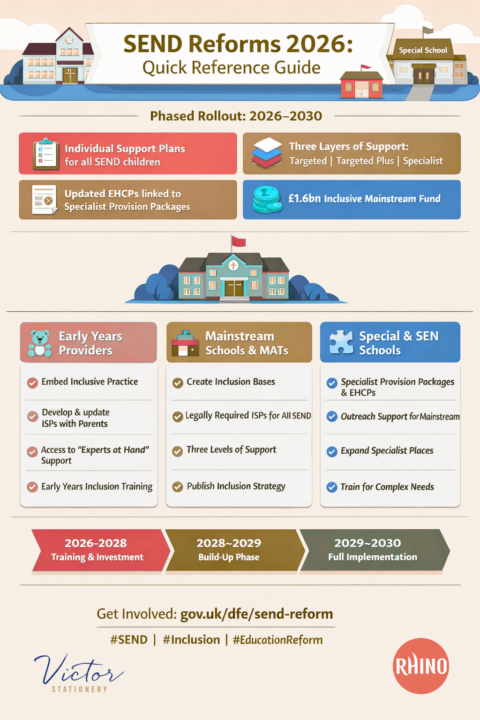
Mainstream Schools & MATs:
- Inclusive Mainstream Offer: All schools must deliver high-quality, inclusive teaching.
- Individual Support Plans (ISPs): Legally required for every child with identified SEND. Developed with parents and updated regularly.
- Three Flexible Layers of Support: Targeted, Targeted Plus (with Experts at Hand), Specialist (linked to Specialist Provision Packages). Children can move between layers as needs evolve.
- Inclusion Bases: Every secondary school (and many primary schools) will have a dedicated space for targeted SEND support.
- EHCPs Remain: Updated, digital, and linked to Specialist Provision Packages to ensure national consistency.
What Schools Must Do:
- Embed inclusive practice across all settings.
- Engage with the national SEND training programme.
- Collaborate with local authorities, healthcare professionals, and families.
- Publish an Inclusion Strategy for accountability and transparency.
Specialist / SEN Schools:
- Specialist Provision Packages: Clear standards for children with complex needs; your expertise will guide mainstream settings on delivery.
- EHCPs Remain Critical: All children with complex needs will have updated, digital EHCPs linked to Specialist Provision Packages.
- Dual Role: SEN schools will continue providing high-quality education while supporting outreach to mainstream schools, including training and guidance.
- Increased Capacity: £3.7 billion investment to create 60,000 new SEND places, including inclusion bases and accessible facilities.
- National Consistency: Ending the postcode lottery in support; families can expect the same standard of provision wherever they live.
What SEN Schools Should Do:
- Share expertise with local mainstream schools and early years settings.
- Collaborate on Individual Support Plans and Specialist Provision Packages.
- Prepare for phased implementation from 2026–2030, with first assessments in 2029.
- Participate in national training programmes to ensure staff are confident supporting complex needs.
For Early Years Providers:
- Access to Experts at Hand
- National inclusion training
- £47m additional early years inclusion funding (2026–27)
- Funding via the £1.6bn Inclusive Mainstream Fund
- Stronger collaboration with Best Start Family Hubs
- Fast-track route for under-5s with complex needs
What Early Years Settings Must Do:
- Embed inclusive practice as standard
- Support early identification (including 2-year progress checks)
- Contribute to Individual Support Plans
- Work closely with schools to strengthen transitions into Reception
For Parents & Families
- Earlier support without long battles
- Clearer legal entitlements
- National consistency
- Stronger local provision
- Improved mediation and complaints processes
Timeline: What Happens When?
2026–2028
Workforce training begins
Funding distributed
National Inclusion Standards introduced
Specialist Provision Packages published
2029
New legislation expected
First needs assessments under the new system
2030 onwards
Children transition when moving education phases
Full system operational
No changes affect existing placements before 2030.
The Consultation: Your Voice Matters
The SEND consultation is open for 12 weeks, closing on 18 May 2026.
The government describes this as the “biggest national conversation on SEND in a generation” and says reform will continue to evolve based on feedback.
Families, educators and professionals are encouraged to respond:
- You can also respond to this consultation via email at SENDreform.CONSULTATION@education.gov.uk, or by post to:
- SENDAP Reform, Sanctuary Buildings, Great Smith Street, London, SW1P 3BT
Final Thoughts
The vision set out in Every Child Achieving and Thriving is ambitious. It aims to rebuild trust in a system many families feel has failed them.
If delivered effectively, these reforms could:
- Strengthen mainstream inclusion
- Provide earlier support
- Reduce adversarial processes
- Standardise provision nationally
- Protect specialist education for those who need it
However, success will depend not only on funding and legislation, but on implementation, workforce capacity, and whether families genuinely experience less conflict and greater clarity.
The coming consultation period will be crucial in shaping what this new SEND system ultimately becomes.
Practical Inclusion Starts in the Classroom
As schools and settings prepare for strengthened inclusion expectations and National Inclusion Standards, practical adjustments in everyday learning environments will matter more than ever.
Simple adaptations including the use of SEN-friendly tinted paper to reduce visual challenges and support processing can make a meaningful difference for many learners.
If you're looking to strengthen inclusive practice in your setting, we offer a range of award-winning SEN-friendly tinted paper products, including:
Exercise books
Notebooks
Writing pads
Journals
Designed to support learners with visual, dyslexia and other additional needs, our products can help create calmer, more accessible classroom experiences.
If you enjoyed the article and want more content like this here’s what you can do:
- Subscribe to our RHINO Stationery Email Marketing Newsletter, where we bring you all the latest on educational insights, product updates and share tips on the latest stationery trends that are shaping work and learning spaces.
- You can also connect with us on our RHINO Stationery socials - Facebook, Instagram, TikTok, LinkedIn, or X
- Give us a follow 🤲 and tag @RHINOStationery for a chance to be featured! #BuyingRhinoSavesRhinos
Our Newsletter is your go-to hub for:
👉 The latest stationery trends that are shaping work and learning spaces
👉 Educational insights to support focus and creativity
👉 Exclusive first looks at our newest product launches
If you’re passionate about educational stationery, children's mental health and sustainable practices, this one’s for you.
🔗 Subscribe now and never miss a page-turning update!
 Other News