
When Should Pupils Move From Handwriting Lines to Standard Ruling?

As corporate members of the National Handwriting Association, we know Handwriting is a foundational skill that supports spelling, Handwriting is a foundational skill that supports spelling, composition, confidence and even cognitive development. For KS1 and KS2 teachers, one of the most common questions we hear at RHINO is "When should pupils should move from handwriting lines to standard ruling?". We completely understand your concerns, if you move too early then letter formation can suffer; and leaving it too late and pupils may struggle to adapt to everyday writing expectations.
With #NationalHandwritingDay highlighting the importance of handwriting, it’s the perfect time to have these conversations in schools, education settings, private tutors and educational specialists. We explore handwriting progression across KS1 and KS2 and consider how best to support all learners, including those with additional needs.
Handwriting lines provide an effective foundation for teaching letter formation, size, and spatial placement. Handwriting instruction is a developmental and sequential process that requires consistent, high-quality instruction. Beginning with simple shaded lines supports early skill development and promotes correct writing habits.
Michelle Stone, National Handwriting Association Co-Vice Chair

Why Handwriting Lines Matter in the First Place
Handwriting lines provide crucial visual structure for early writers. They help pupils understand:
- Letter height (ascenders and descenders)
- Consistent sizing
- Baseline alignment
- Spacing between letters and words
In the early stages of handwriting progression in KS1, these guides reduce cognitive load. Pupils can focus on letter formation and motor control, rather than worrying about where letters should sit.
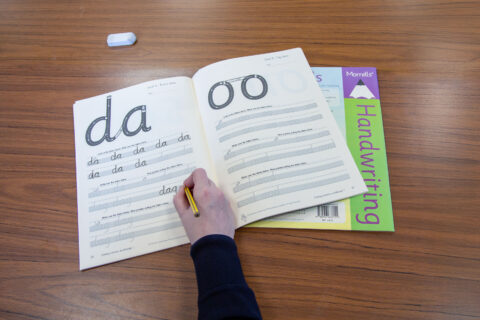
Structured resources such as Morrells Handwriting books and RHINO handwriting books are specifically designed to support this developmental stage, gradually building independence while maintaining clarity and consistency.

Typical Handwriting Progression: KS1 to KS2
While every child develops at a different pace, there are general expectations teachers can use as a guide.
Early KS1 (Reception – Year 1)
At this stage, pupils should remain on wide or structured handwriting lines. These often include:
- A clear baseline
- Midline guidance
- Top line indicators
The focus here is on:
- Correct letter formation
- Developing fine motor strength
- Establishing left-to-right orientation
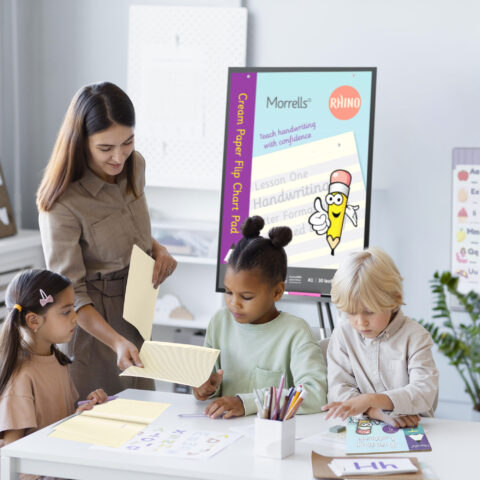
Tools like a handwriting flip chart are particularly effective for modelling correct formation and supporting whole-class teaching.
Late KS1 (Year 2)
This is often the transition phase. Pupils may begin to move to narrower handwriting lines as confidence grows.
Pupils are usually ready to transition when they can:
- Form all letters correctly and consistently
- Maintain letter size across a line
- Keep letters sitting accurately on the baseline
Not all pupils will reach this point at the same time. For some, particularly those using SEN books, extended use of handwriting lines is not only appropriate but essential.
Lower KS2 (Year 3 – Year 4)
Many pupils will be ready to move to standard ruling during lower KS2, but this should be gradual.
A staggered approach works best:
- Start with lined paper that has subtle guidance
- Model writing on standard ruling regularly
- Allow pupils to switch back to handwriting lines when needed
High-quality progression materials such as RHINO handwriting books support this transition by maintaining structure without over-scaffolding.
Upper KS2 (Year 5 – Year 6)
By this stage, most pupils should be confidently writing on standard ruled paper. However, handwriting development doesn’t stop here.
Teachers should continue to reinforce:
- Legibility under speed
- Consistent letter sizing
- Writing stamina
Signs a Pupil Is Ready to Move to Standard Ruling
Rather than relying solely on age or year group, look for these indicators:
- Letters are consistently formed and sized
- Ascenders and descenders are clear
- Words sit neatly on the line
- Writing remains legible when speed increases
If handwriting deteriorates once pupils move to standard ruling, it’s a sign they may need more time with handwriting lines, and that’s absolutely fine!
Common Mistakes to Avoid
- Moving too quickly to standard ruling because “everyone else has”
- Removing handwriting lines completely instead of offering choice
- Assuming neat handwriting equals strong handwriting foundations
Handwriting is a developmental process, not a quick, tick-box exercise.
Supporting SEN and Handwriting
For some pupils, handwriting lines may remain an important support throughout KS2. Children with fine motor difficulties, dyslexia, or coordination challenges often benefit from continued structure.
Specialist SEN books and carefully designed handwriting resources help maintain progress while protecting self-esteem.
Why Handwriting Still Matters
In an increasingly digital world, it’s easy to underestimate the importance of handwriting. Research continues to show links between handwriting and:
- Memory retention
- Spelling accuracy
- Idea generation
- Writing fluency
There’s no single “right” moment for pupils to move from handwriting lines to standard ruling. The key is responsive teaching, informed observation, and access to high-quality resources such as Morrells Handwriting, RHINO handwriting books, handwriting flip charts, and SEN-specific materials.
By respecting individual readiness and prioritising handwriting progression across KS1 and KS2, teachers can help every pupil develop handwriting that is functional, fluent and confidence-building.
If you enjoyed the article and want more content like this here’s what you can do:
- Subscribe to The Victor Stationery LinkedIn Newsletter to get notified when a new article is released comes out.
- Subscribe to our RHINO Stationery Email Marketing Newsletter, where we bring you all the latest on educational insights, product updates and share tips on the latest stationery trends that are shaping work and learning spaces.
- You can also connect with us on our RHINO Stationery socials - Facebook, Instagram, TikTok, LinkedIn, or X
- Give us a follow 🤲 and tag @RHINOStationery for a chance to be featured! #BuyingRhinoSavesRhinos
Our Newsletter is your go-to hub for:
👉 The latest stationery trends that are shaping work and learning spaces
👉 Educational insights to support focus and creativity
👉 Exclusive first looks at our newest product launches
If you’re passionate about educational stationery, children's mental health and sustainable practices, this one’s for you.
🔗 Subscribe now and never miss a page-turning update!
 Other News